Category: Outreach

Any Outreach efforts, i.e. Madison Garden with Story Church

  • Service Advisory – Edgewater (44102) Power Outage

    Service Advisory – Edgewater (44102) Power Outage

    Service Advisory – Edgewater (44102) Power Outage

    Power Outage Affecting Edgewater Properties (44102)

    A neighborhood-wide power outage is currently affecting our Edgewater properties in the 44102 area. This outage is impacting the surrounding neighborhood and is not isolated to Stay With Jay properties.

    At this time:

    • Internet service is unavailable at our Edgewater locations due to the power outage.
    • Our team is actively relocating guests between available rooms and properties for those who wish to be accommodated elsewhere.
    • Alternative accommodations are available, subject to availability.

    Refund Requests

    If you no longer wish to stay due to the outage, please contact us through the booking platform (Airbnb, Booking.com, Vrbo, etc.) before checking in and clearly indicate that your request is related to the power outage.

    Because we have alternative accommodations available, refund requests are evaluated through the platform prior to check-in. Requests made after check-in or after choosing to occupy the accommodation may be handled differently according to the applicable booking platform’s policies.

    We appreciate your patience and understanding while utility crews work to restore service to the neighborhood. We will continue to provide updates as additional information becomes available.

  • Why Do People Who Need Money the Most Often Make the Most Ex

    Why Do People Who Need Money the Most Often Make the Most Ex

    Why Do People Who Need Money the Most Often Make the Most Expensive Decisions?

    Observations from more than 10,000 Airbnb nights per year.

    Over the better part of a decade, I’ve operated affordable accommodations in Cleveland.

    During that time, our company has hosted tens of thousands of reservation nights. More importantly, we’ve welcomed thousands of unique guests.

    This isn’t an academic study.

    It’s a front-row seat to how ordinary people live.

    More than 63% of our guests tell us they chose Stay With Jay for one simple reason:

    We were the most affordable option.

    That matters because affordability isn’t just our marketing strategy—it’s our operating philosophy.

    We intentionally try to keep our guests’ total housing costs low.

    A one- or two-night stay often works out to under $60 per night.

    Longer weekly stays approach $50 per night.

    Monthly stays can fall to approximately $45 per night.

    Those prices include utilities, Wi-Fi, parking, laundry, and weekly room turns. We try to eliminate the hidden expenses that quietly make life more expensive.

    Yet something fascinating happens after guests arrive.

    The Paradox

    Many guests work hard to save $10 choosing an affordable room.

    Then spend $30 on Uber.

    Twice.

    Sometimes three times.

    The next morning, instead of cooking in a fully equipped kitchen, breakfast arrives through DoorDash.

    Lunch comes through Uber Eats.

    Dinner follows.

    None of these choices, by themselves, are irrational.

    I use Uber.

    I order delivery.

    Most people do.

    The difference is frequency.

    When transportation costs exceed housing costs…

    when convenience becomes a daily habit…

    small decisions become expensive lifestyles.

    The Popcorn Guest

    One pattern appears again and again.

    Internally, I call them “popcorn guests.”

    They bounce from one reservation to another.

    One night here.

    Two nights there.

    Another booking somewhere else.

    Then back again.

    Some have accumulated more than 200 nights with us over several years.

    One guest had over 40 check-ins and check-outs in just ninety days.

    That isn’t unusual in affordable housing.

    What fascinates me isn’t the number of stays.

    It’s the consistency of the surrounding decisions.

    The Math Doesn’t Care

    Suppose transportation averages $30 per day.

    Housing averages $53.

    Before food, before clothing, before your phone bill…

    life already costs $83 every day.

    Round that to roughly $100 after taxes and income requirements.

    That’s approximately $3,000 per month before eating.

    Now add restaurant meals because the kitchen sits unused.

    The financial picture changes dramatically.

    Again…

    None of these decisions are individually catastrophic.

    Together, they become a system.

    This Isn’t About Blame

    It’s easy to say,

    “They should just cook.”

    “They should ride the bus.”

    “They should budget better.”

    Reality is rarely that simple.

    Time.

    Stress.

    Mental bandwidth.

    Transportation.

    Neighborhood safety.

    Work schedules.

    Childcare.

    Energy after a twelve-hour shift.

    All influence decision making.

    Understanding behavior is far more valuable than judging it.

    What If Hospitality Could Help?

    This question has become increasingly important to me—not just as a host, but as a business owner.

    If we understand these patterns…

    could we design an environment that naturally leads to better outcomes?

    Not by forcing behavior.

    By reducing friction.

    Perhaps the answer isn’t cheaper rooms.

    Perhaps it’s helping guests use the kitchens more often.

    Maybe it’s highlighting nearby grocery stores the day before check-in.

    Maybe it’s surfacing bus routes inside the guest portal.

    Maybe it’s sending targeted promotions based on length of stay.

    Maybe it’s helping repeat guests consolidate bookings instead of constantly moving.

    Maybe it’s introducing referral programs or loyalty rewards that reinforce financially healthy behaviors.

    The point isn’t to tell people how to live.

    The point is to design hospitality that makes the better choice the easier choice.

    Subscription Behavior Without a Subscription

    Here’s another observation.

    Stay With Jay is not a subscription business.

    Yet roughly 60% of our revenue comes from guests who behave like subscribers.

    They return.

    Again.

    And again.

    And again.

    Every reservation is another vote of confidence.

    They trust us enough to sleep under our roof.

    That trust is incredibly valuable.

    It also creates an opportunity.

    Not simply to earn another reservation.

    But to improve the guest’s experience beyond the room itself.

    Keep More Per Stay. Earn More Per Stay.

    The lesson isn’t that poor people make poor decisions.

    The lesson is that everyone makes decisions within the environment they’re given.

    If we can design that environment better…

    our guests may keep more of what they earn.

    And if our guests keep more…

    they’re more likely to return.

    That creates a rare outcome where everyone’s interests align.

    Guests build greater financial stability.

    We build a stronger business.

    Communities become healthier.

    Sometimes the best hospitality isn’t a nicer room.

    It’s helping someone leave with a little more money than they would have otherwise.

    Keep More Per Stay. Earn More Per Stay.

  • Is Cleveland STR Dead? Not Yet — But the Next Six Months Wil

    Is Cleveland STR Dead? Not Yet — But the Next Six Months Wil

    After attending Cleveland City Council’s Finance meeting on the proposed short-term rental legislation, one thing became clear: this is no longer just a debate about party houses, neighborhood nuisances, or whether short-term rentals should be regulated.

    This is now a serious compliance and survival question for responsible Cleveland short-term rental owners.

    The proposal is not simply asking operators to get organized. It creates a licensing system, a density cap, insurance requirements, occupancy limits, possible revocation, civil fines, and even misdemeanor exposure for operating without the right approval. The current ordinance file is Ordinance No. 561-2026, and the official Cleveland legislation page lists it as short-term rental legislation amending the city’s licensing, tax, zoning, and limited-lodging rules.

    So the question many local hosts are now asking is simple:

    Is Cleveland STR dead?

    The answer is: not yet.

    But if the city moves forward without better data, a clear variance process, and a surgical enforcement strategy, responsible STR operators may be treated the same as nuisance properties — and that would be a major mistake.

    The Reasonable Parts Are Not the Problem

    Let’s be fair. Not everything in the proposal is unreasonable.

    A license requirement can make sense. A local contact requirement can make sense. An occupancy limit can make sense. Requiring insurance can make sense. Under the amended draft, applicants would need proof of at least $500,000 in liability insurance, and the overnight occupancy limit would be two people per bedroom plus two additional people.

    Those are safety and accountability rules. Many responsible operators can live with that.

    The problem is not regulation itself.

    The problem is using a blunt density cap and criminal-style enforcement before the city has clearly answered basic questions:

    How many STRs are actually operating in Cleveland?

    Which blocks are already over the proposed cap?

    Which properties have nuisance patterns?

    Which operators have clean records?

    Which guests will lose affordable lodging options?

    And how many local residents rely on this income to pay mortgages, taxes, repairs, and rising costs?

    The Big Surprise: Cleveland Still Needs the Data

    One of the most surprising parts of this whole process is that the city appears to be moving toward aggressive enforcement without a clean, complete picture of the STR inventory.

    This is not a small detail. It is the foundation of the entire policy.

    In 2025, Ideastream reported that Cleveland estimated there were between 900 and 1,500 short-term rentals, but officials said it was uncertain how many there were for sure. In 2026, Ideastream again reported that Council Member Austin Davis said Ohio City and Tremont were likely among the densest areas for STRs, but that without a registry, there was no way to be sure.

    That should make everyone pause.

    Because this legislation includes a 10% density cap in residential districts. The amended draft says short-term rentals are limited to at least one, or no more than 10% of total residential units on the block or in a multi-unit building, whichever is greater.

    But 10% of what?

    Which block count?

    Which units?

    Which listings?

    Which active operators?

    Which inactive listings?

    Which properties have actual documented complaints?

    Which ones are simply being swept into the same category?

    If a local operator can pull market data in a morning, and if citywide listing data can be purchased from third-party sources for a modest cost, then the city should not be legislating in the dark. Cleveland should be able to map STRs by block, cross-reference complaints, identify repeat nuisance properties, and separate responsible operators from the true problem properties.

    That is the surgical approach.

    A citywide blunt instrument is not surgical.

    The Penalties Change Everything

    The most serious part of the amended draft is not the $150 license fee. It is not the insurance requirement. It is not even the occupancy limit.

    The most serious part is the penalty structure.

    Under the amended draft, operating a short-term rental without a valid license is a first-degree misdemeanor, punishable by a fine of up to $1,000, up to six months imprisonment, or both. Operating without a required variance is also listed as a first-degree misdemeanor.

    Separately, the civil penalties include a $5,000 fine for operating without a valid license and another $5,000 fine for operating without a required variance.

    That is a major escalation.

    Before Cleveland attaches criminal penalties and $5,000 fines to noncompliance, the city should know exactly who it is regulating and why.

    There is a big difference between a party house that creates violence, parking problems, trash, and noise — and a responsible host serving travel nurses, families, medical visitors, workers, and guests who cannot afford or do not want downtown hotel prices.

    The law should know that difference too.

    Variances Are Now the Center of the Strategy

    If this legislation passes in its current form, variances may become the most important word in the Cleveland STR conversation.

    The draft says an owner or operator may apply to the Board of Zoning Appeals for a variance if the short-term rental would exceed the density cap. The Board may consider factors such as whether the property previously operated as an STR, whether there were documented complaints, whether the use affects neighborhood quality, whether parking is impacted, whether it is a whole-home STR or partial-home STR, whether other over-cap STRs already exist on the block, and whether residents or tenants support the variance in a multi-unit building.

    That means every responsible operator should immediately begin building a property-by-property compliance file.

    That file should include booking history, tax records, proof of insurance, proof of prior operation, house rules, no-party policies, guest screening procedures, parking plans, safety features, cleaning records, neighbor communication, and any evidence of a clean complaint history.

    This is no longer only a political debate. It is now an administrative survival process.

    The Six-Month Amendment Cleveland Needs

    The amended draft says the new STR provisions and related zoning changes would take effect 180 days after passage.

    That six-month window should not be wasted.

    Cleveland should use that period to add a practical implementation amendment:

    Before enforcement begins, the city should spend a defined portion of the expected enforcement budget — even 10% — to purchase, compile, and analyze STR data citywide.

    That analysis should identify:

    • The actual number of active STR listings.
    • The number of STRs by block.
    • The number of residential units by block.
    • Which blocks exceed the 10% cap.
    • Which properties have documented nuisance calls or violations.
    • Which operators have clean records.
    • Which listings appear inactive, duplicate, or noncompliant.
    • Which properties are paying taxes.
    • Which guests and neighborhoods may be affected by reduced lodging options.

    Then the city should publish the findings before penalties begin.

    That is how you regulate intelligently.

    Data first. Variances second. Fines last.

    Airbnb Is Not the Same as Local Hosts

    Another point needs to be said clearly: Airbnb is a platform. It is a middleman.

    If Airbnb is involved in the policy conversation, that does not automatically mean local hosts are protected. Airbnb makes money from transactions. Whether those transactions are spread across many small hosts or concentrated among fewer larger operators, the platform still has a business model.

    Local hosts are different.

    Local hosts have mortgages. Local hosts repair Cleveland houses. Local hosts pay local contractors, cleaners, landscapers, insurance bills, utilities, property taxes, and city fees. Local hosts are the people who will have to navigate the variance process, absorb the insurance costs, comply with lead-safe rules, and face fines if the rules are unclear.

    Do not confuse platform compliance with host protection.

    Guests Are Being Left Out of the Conversation

    The other missing voice is the guest.

    People talk about STRs as if the only stakeholders are investors and neighbors. But guests matter too.

    Travel nurses use short-term rentals. Contract workers use them. Families visiting elderly parents use them. People coming to Cleveland for medical appointments use them. Weekend travelers use them. Visitors who want to stay near Edgewater, Gordon Square, Ohio City, Tremont, MetroHealth, or a family member’s neighborhood use them.

    In our own experience, many guests save meaningful money compared with hotels — sometimes around $40 per night in comparable accommodations. That matters.

    For someone staying a week, that can be groceries.

    For someone staying a month, that can be hundreds of dollars.

    For a travel nurse or traveling worker, that can be the difference between Cleveland being affordable or not.

    And when responsible neighborhood lodging disappears, guests do not magically become Cleveland residents. They get pushed downtown, priced out, or pushed into worse lodging options.

    So, Is Cleveland STR Dead?

    No.

    But Cleveland STR is entering a new phase.

    The casual era is over. The compliance era is here.

    Responsible operators need to prepare for licensing, insurance, documentation, density calculations, lead-safe certification, neighbor communication, and possibly variances.

    Council, meanwhile, needs to slow down enough to distinguish between nuisance properties and responsible operators. The city should not criminalize noncompliance before it has built a clear, data-driven path to compliance.

    Cleveland does not need to choose between neighborhoods and responsible STRs.

    It can protect residents, shut down party houses, preserve housing goals, and still allow well-run short-term rentals to serve workers, families, medical visitors, and travelers.

    But that requires precision.

    Not panic.

    Not guesswork.

    Not a blanket cap without a public map.

    Before Cleveland decides whether STR is dead, the city should at least know exactly what it is killing.

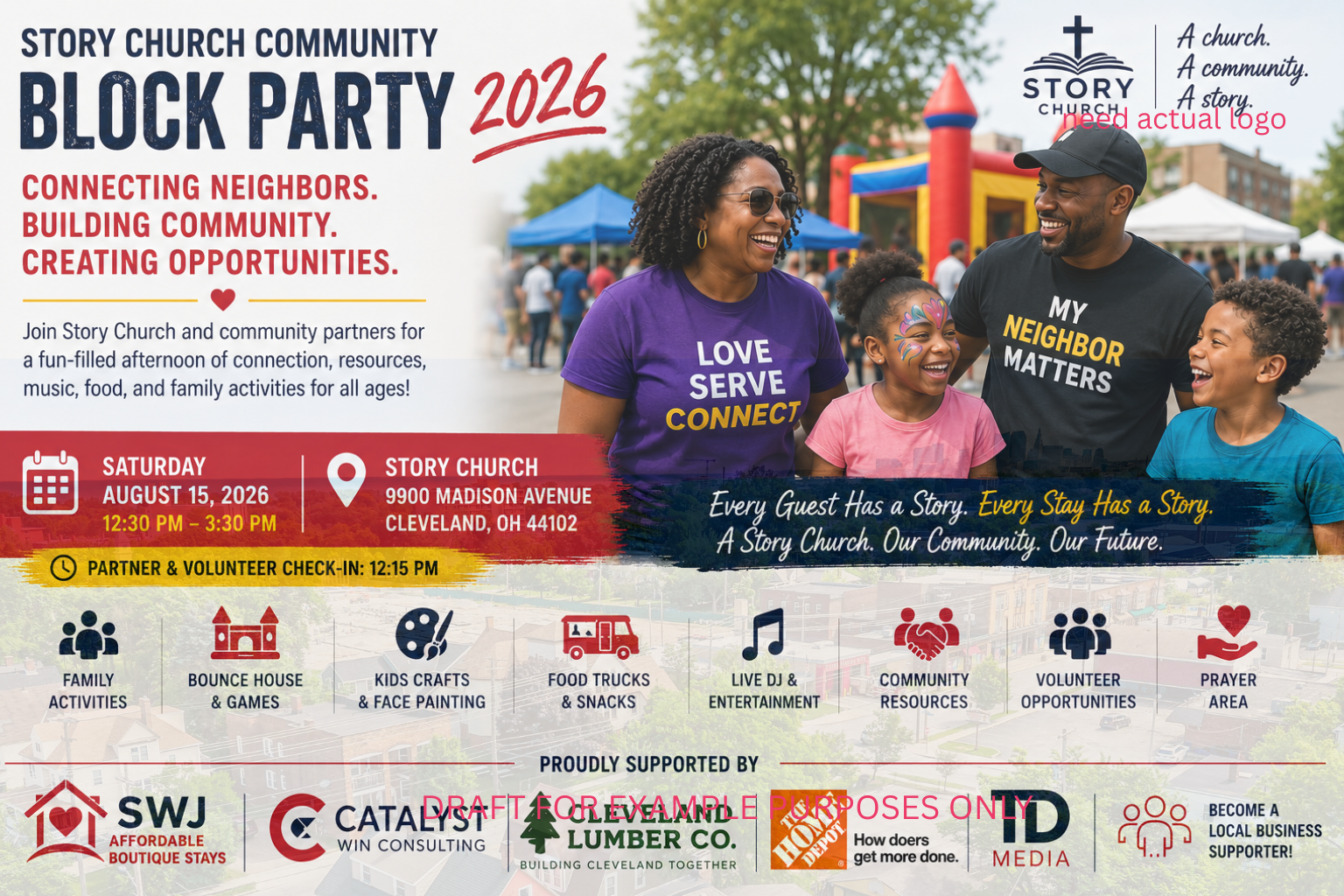
  • Story Church Community Block Party 2026

    Story Church Community Block Party 2026

    Connecting Neighbors. Building Community. Creating Opportunities.

    On Saturday, August 15, 2026, neighbors, local organizations, volunteers, churches, businesses, and community leaders will gather at Story Church, located at 9900 Madison Avenue in Cleveland, for a day dedicated to strengthening relationships, sharing resources, and celebrating the people who make our neighborhoods special.

    Hosted and organized by Story Church, the Story Church Community Block Party is designed to bring together residents, families, partner agencies, and local organizations in a welcoming environment focused on connection, service, and community engagement.

    Why This Event Matters

    Strong communities are not built through social media posts or city meetings alone. They are built when neighbors meet neighbors, when organizations collaborate, when volunteers show up, and when people invest their time in creating a better future together.

    Story Church has embraced that mission by creating an event where residents can:

    • Meet local service providers
    • Discover educational opportunities
    • Connect with community organizations
    • Learn about neighborhood resources
    • Enjoy family-friendly activities
    • Explore volunteer opportunities
    • Build lasting relationships with fellow residents

    The event is expected to welcome approximately 175 attendees, creating opportunities for meaningful conversations and new partnerships throughout the afternoon.


    Event Details

    Event: Story Church Community Block Party
    Date: Saturday, August 15, 2026
    Time: 12:30 PM – 3:30 PM
    Location: Story Church
    Address: 9900 Madison Avenue, Cleveland, Ohio

    Partner agencies and participating organizations are encouraged to arrive by 12:15 PM for setup.


    Activities and Attractions

    The event site plan includes a wide variety of activities designed to engage attendees of all ages:

    Family Activities

    • Bounce House
    • Playground Activities
    • Kids Games
    • Balloon Creations
    • Kids Craft Area
    • Face Painting / Photo Booth

    Community Engagement

    • Registration and Welcome Area
    • Volunteer Information Center
    • Community Resource Tables
    • Partner Agency Booths
    • Neighborhood Information Displays

    Entertainment

    • Live DJ and Music Stage
    • Community Performances
    • Interactive Activities

    Food and Refreshments

    • Food Trucks
    • Popcorn
    • Lemonade

    Wellness and Services

    • Haircut Station
    • Prayer Area hosted near Sisters Haven

    Community Partnerships Welcome

    Story Church is actively working with partner organizations, nonprofits, service providers, educational institutions, neighborhood groups, and businesses that want to participate in this event.

    Organizations are welcome to:

    • Host an information table
    • Share community resources
    • Provide family activities
    • Distribute educational materials
    • Offer giveaways
    • Recruit volunteers
    • Build relationships with local residents

    The goal is simple: create meaningful connections that continue long after the event ends.


    Volunteers Make It Possible

    Events like this depend on community volunteers.

    More than two dozen volunteer positions are planned throughout the event, supporting:

    • Registration
    • Vendor coordination
    • Children’s activities
    • Food areas
    • Community engagement stations
    • Entertainment support
    • Setup and breakdown operations

    Every volunteer contributes to creating a welcoming experience for neighbors and visitors alike.


    The Story Behind Story Church

    At Stay With Jay, one of our guiding beliefs is simple:

    Every guest has a story. Every stay has a story.

    That philosophy resonates deeply with the mission of Story Church.

    Communities are ultimately collections of stories. Stories of families building a future. Stories of neighbors helping neighbors. Stories of newcomers finding belonging. Stories of organizations serving people in practical ways.

    The Story Church Community Block Party is more than an afternoon of activities. It is an opportunity for those stories to intersect.

    It is where a resident may discover a new resource.

    Where a child may meet a mentor.

    Where a volunteer may find a purpose.

    Where a local organization may find a partner.

    And where a neighborhood can become stronger through connection.


    Building a Stronger West Side Cleveland

    The neighborhoods surrounding Madison Avenue have a rich history of resilience, diversity, entrepreneurship, and community pride.

    Events like the Story Church Community Block Party help strengthen those foundations by bringing people together in a positive environment where relationships can grow and opportunities can be shared.

    Whether you are a resident, volunteer, nonprofit leader, educator, business owner, faith leader, or simply someone who cares about Cleveland, this event represents an opportunity to invest in the future of our community.


    Keywords for Search

    Story Church Cleveland • Story Church Community Block Party • Cleveland Community Event • Cleveland Block Party 2026 • Madison Avenue Cleveland Events • Family Events Cleveland Ohio • Volunteer Opportunities Cleveland • Community Resources Cleveland • West Side Cleveland Neighborhood Event • Cleveland Nonprofit Partnerships • Community Engagement Cleveland • Family Fun Cleveland • Neighborhood Block Party Cleveland • Story Church Madison Avenue • Cleveland Community Building Event

    Join us on August 15, 2026, as neighbors, organizations, and community leaders come together to connect, serve, and build a stronger Cleveland.