Category: Catalyst Win Consulting

Take the next obvious step

  • See Something Say Something…

    See Something Say Something…

    See something, say something.

    We always encourage our guests to communicate any abnormalities seen in our residences, as soon as they see it.

    In todays world this is more important than ever.

    We have recently started implementing a dedicated residence bound whatsap group. This group will be always managed by a local host, ready to respond to any inquiries and point the existing guests to the appropriate solution to their needs.

    This is an innovative (to us), albeit, really simple method that will ensure our current staying guests get all the information they need, first, and without any intermediaries.

    What should our guests expect?

    In our guest portal, a “whatsapp” button with the residence name and or logo will be seen. This will automatically open the WhatsApp app in our guests phones, or it will prompt our guests to download the app.

    Possible difficulties to our guests?

    The newness of the app for our US guests, who are the great majority of our guests, is a challenge we are willing to take. Using this group is by no means mandatory, it will simply be the quickest way to get a response from the local host team about residence situations.


    What this is not

    The whatsap residence group is not a forum for guests to make changes to their reservation, these changes can be done on their guest portal, or their OTA portal.

    What this is

    A super secure, encrypted end to end, light communication platform owned by META, used by a vast majority of the world population, where group communication is seamless, better than your typical sms, and it works with any operating system.

    A way to ensure any safety, emergency situation is easily communicated with the guests who are actually staying in the residence. Ensuring the best possible outcome in any emergency situation.


    AI was not used in the creation of this document.


  • Weekly STR Market Analysis

    Weekly STR Market Analysis

    Did you know that almost 40% of total listings in Cleveland ohio have a firm cancellation policy? Yes, close to 40% of hosts, and hotels have a cancellation policy that is either non -refundable or has some type of strict restrictions. Only 24% of listings have a flexible cancellation policy. The gap between % of listings and % booked based on the cancellation policy type is as follows, the looser your cancellation policy the more bookings you get, but the difference is not huge. For example Flexible bookings are about 22% of total listings, but about 24.4% of total bookings are for listings that have those flexible cancelation plicies.

    On the other hand, listings with strict, firm, or super strict policies account for 37.2, and 2.3% of total listings, but only account for 34.6, 2% of total bookings. So there is. gap there.

    How would hosts decide whether flexible or firm is the policy for them?

    extra person fees

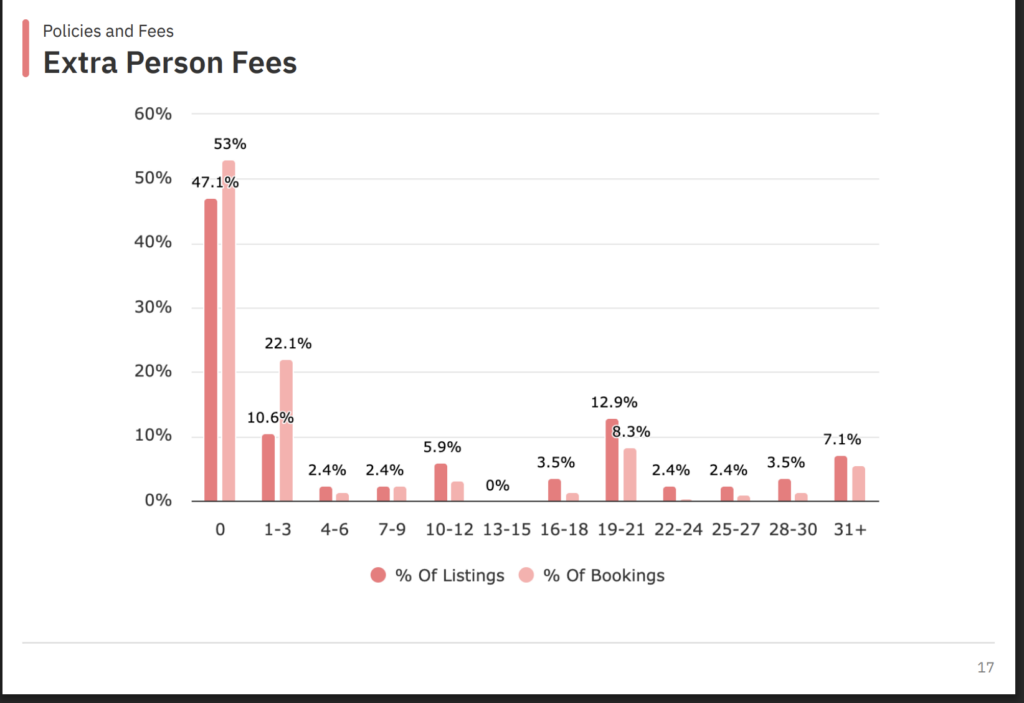
    Over 50% of total listings have an extra person fee attached to them, and they in fact account for 53% of total bookings.

    STR operators should continue leveraging extra person fees, as they do not show a negative correlation with booking patterns. In fact, they perform an even greater function; keep your risks lower. Every micro-hotel high turnover short term rental, should aim to keep the actual count of occupants per room at less than 2 if at all possible. Fees, are one of the effective levers that may be used to achieve just that.

    How much dynamic pricing matters?

    17% of total listings for certain make a high use of dynamic pricing tools, and these listings are taking 26% of the slice of total bookings. That is a big gap.

    9%

    Yes a 9% jump. To smart STR operators, it means if using dynamic pricing, use it fully so you can see the benefit, just more or less using as the graph shows 13% of listings do, actually has the opposite result, 13% of listings use dynamic pricing moderately, but only 8% of bookings goes to those listings.. That is an impressive testatement to effective utilization of operati0onal tools. Is it not?

  • Revenue – sales strategy

    Revenue – sales strategy

    como O time de esportes os clubes por volta dos necrotério do Studio House técnicos de basquete organizações esportivas Federação Paulista de basquete a Federação Paulista de vôleibol Monte Líbano aí onde nós estamos todos os outros clubes por volta da cidade esses clubes trazem atletas de fora da cidade e tem que pagar aluguéis muitas vezes extremamente altos e sem nenhuma garantia de um serviço a D muitas vezes em locais não seguros e aonde entra a estúdio House é onde entra esse conceito e aonde a gente expande até a personalização dos locais de acordo com o clube que patrocina então esse produto pode se chamar concentração House né concentração concentração esportivo esporte House Club House alguma coisa nesse sentido mais o lance é ir atrás desses clientes que são clientes de esportes e obviamente clientes em termos de artistas etcétera etc isso é um tema de discutir com o Elias e é uma ideia avaliar

  • DJ Guest Validates the Studio Haus Model

    DJ Guest Validates the Studio Haus Model

    Why a DJ from Vermilion Validates the Studio Haus Model


    Yesterday, in the dining room and kitchen area of our Edgewater XIV property in Cleveland, I had one of those conversations that no spreadsheet can manufacture — but every spreadsheet eventually confirms.

    Carlos is a repeat guest. He speaks multiple languages. He works three nights a week as a DJ at a downtown Cleveland casino. He lives in Vermilion, Ohio. He drives in, stays strategically, works his shifts, and returns home to raise his child in a quieter town.

    He doesn’t stay with us because of emotion.
    He stays because the numbers make sense.

    Close enough to downtown to work.
    Priced correctly for recurring stays.
    Comfortable enough to feel consistent.

    He understands the model.

    That conversation reaffirmed something critical about Studio Haus.


    The Pattern Behind the Person

    Carlos is not an anomaly. He is represents an underrepresented category.

    He represents a growing segment of professionals who:

    • Do not need to live full-time in a large metropolis
    • Commute into major cities for concentrated work blocks
    • Prioritize cost efficiency without sacrificing comfort
    • Value predictability and operational clarity

    In Cleveland, that looks like someone living in Vermilion and working downtown three nights per week.

    In São Paulo, it may look different in geography — perhaps arriving by bus, metro, or regional transfer — but the psychology is the same.

    Strategic proximity.
    Controlled cost.
    Reliable execution.

    This aligns directly with our corporate housing positioning, where we emphasize affordability, flexibility, and predictable pricing .

    The individual guest and the enterprise client are simply two lenses of the same structural demand.


    Micro-Units, Macro-Shift

    This week, I watched a video discussing the conversion of large commercial buildings in cities like Chicago and New York into micro-units. The criticism was uniformity — identical boxes, maximum density, minimal personality.

    But the underlying data is undeniable.

    Cities are increasing single-occupant housing inventory because the demand exists.

    Our pricing strategy already reflects tiered occupancy designed for individual professionals — standard rooms, suites, and scalable packages .

    The difference?

    Studio Haus does not erase architectural character.
    We adapt it.

    We utilize existing metropolitan structures — intelligently.
    We increase sleeping inventory — strategically.
    We preserve identity — intentionally.

    This is not about compressing space.
    It is about optimizing underutilized space.


    What We’re Actually Selling

    People who often say: “You rent rooms,” they miss the point.

    What we sell is:

    1. Market-backed positioning
    2. Operational repeatability
    3. Strategic pricing discipline
    4. Demand validation through trend analysis

    The corporate housing campaign framework makes this clear: identify industries, decision-makers, and demand clusters, then align inventory and messaging accordingly .

    Carlos validated that model at the micro level.

    Construction managers validate it at scale.
    Travel nurses validate it on contract cycles.
    Consultants validate it by project duration.

    The verticals change.
    The structure does not.


    There is a cool example of this in action from the owner of Casa Paradiso in Guaruja, Sao Paulo. where the owner of the pousada, leverages all OTAs plus his own internal micro sales team to target corporate clients, who during times of baixa temporada, book the entirety of his Pousada.


    From Cleveland to São Paulo

    The Studio Haus concept is not geography-bound.

    It is density-aware.
    It is commuter-aware.
    It is cost-conscious.
    It is stakeholder-aware

    Whether someone drives from Vermilion or takes regional transit into São Paulo, the logic remains:

    • Live where it makes sense.
    • Work where opportunity exists.
    • Stay where execution is seamless.

    That is the product.


    The Layered Build

    We are close.

    Close to having a team aligned on this reasoning.
    Close to articulating the narrative consistently.
    Close to scaling with clarity instead of noise.

    Studio Haus is not a hospitality experiment.

    It is a consulting-driven housing model grounded in observable behavioral trends, structured pricing, and operational discipline.

    Carlos did not intend to validate the thesis.

    But he did.

    And that is how real models are confirmed — not in theory, but in conversation.