como O time de esportes os clubes por volta dos necrotério do Studio House técnicos de basquete organizações esportivas Federação Paulista de basquete a Federação Paulista de vôleibol Monte Líbano aí onde nós estamos todos os outros clubes por volta da cidade esses clubes trazem atletas de fora da cidade e tem que pagar aluguéis muitas vezes extremamente altos e sem nenhuma garantia de um serviço a D muitas vezes em locais não seguros e aonde entra a estúdio House é onde entra esse conceito e aonde a gente expande até a personalização dos locais de acordo com o clube que patrocina então esse produto pode se chamar concentração House né concentração concentração esportivo esporte House Club House alguma coisa nesse sentido mais o lance é ir atrás desses clientes que são clientes de esportes e obviamente clientes em termos de artistas etcétera etc isso é um tema de discutir com o Elias e é uma ideia avaliar
Category: Thoughts
-

DJ Guest Validates the Studio Haus Model
Why a DJ from Vermilion Validates the Studio Haus Model
Yesterday, in the dining room and kitchen area of our Edgewater XIV property in Cleveland, I had one of those conversations that no spreadsheet can manufacture — but every spreadsheet eventually confirms.
Carlos is a repeat guest. He speaks multiple languages. He works three nights a week as a DJ at a downtown Cleveland casino. He lives in Vermilion, Ohio. He drives in, stays strategically, works his shifts, and returns home to raise his child in a quieter town.
He doesn’t stay with us because of emotion.
He stays because the numbers make sense.Close enough to downtown to work.
Priced correctly for recurring stays.
Comfortable enough to feel consistent.He understands the model.
That conversation reaffirmed something critical about Studio Haus.
The Pattern Behind the Person
Carlos is not an anomaly. He is represents an underrepresented category.
He represents a growing segment of professionals who:
- Do not need to live full-time in a large metropolis
- Commute into major cities for concentrated work blocks
- Prioritize cost efficiency without sacrificing comfort
- Value predictability and operational clarity
In Cleveland, that looks like someone living in Vermilion and working downtown three nights per week.
In São Paulo, it may look different in geography — perhaps arriving by bus, metro, or regional transfer — but the psychology is the same.
Strategic proximity.
Controlled cost.
Reliable execution.This aligns directly with our corporate housing positioning, where we emphasize affordability, flexibility, and predictable pricing .
The individual guest and the enterprise client are simply two lenses of the same structural demand.
Micro-Units, Macro-Shift
This week, I watched a video discussing the conversion of large commercial buildings in cities like Chicago and New York into micro-units. The criticism was uniformity — identical boxes, maximum density, minimal personality.
But the underlying data is undeniable.
Cities are increasing single-occupant housing inventory because the demand exists.
Our pricing strategy already reflects tiered occupancy designed for individual professionals — standard rooms, suites, and scalable packages .
The difference?
Studio Haus does not erase architectural character.
We adapt it.We utilize existing metropolitan structures — intelligently.
We increase sleeping inventory — strategically.
We preserve identity — intentionally.This is not about compressing space.
It is about optimizing underutilized space.
What We’re Actually Selling
People who often say: “You rent rooms,” they miss the point.
What we sell is:
- Market-backed positioning
- Operational repeatability
- Strategic pricing discipline
- Demand validation through trend analysis
The corporate housing campaign framework makes this clear: identify industries, decision-makers, and demand clusters, then align inventory and messaging accordingly .
Carlos validated that model at the micro level.
Construction managers validate it at scale.
Travel nurses validate it on contract cycles.
Consultants validate it by project duration.The verticals change.
The structure does not.There is a cool example of this in action from the owner of Casa Paradiso in Guaruja, Sao Paulo. where the owner of the pousada, leverages all OTAs plus his own internal micro sales team to target corporate clients, who during times of baixa temporada, book the entirety of his Pousada.
From Cleveland to São Paulo
The Studio Haus concept is not geography-bound.
It is density-aware.
It is commuter-aware.
It is cost-conscious.
It is stakeholder-awareWhether someone drives from Vermilion or takes regional transit into São Paulo, the logic remains:
- Live where it makes sense.
- Work where opportunity exists.
- Stay where execution is seamless.
That is the product.
The Layered Build
We are close.
Close to having a team aligned on this reasoning.
Close to articulating the narrative consistently.
Close to scaling with clarity instead of noise.Studio Haus is not a hospitality experiment.
It is a consulting-driven housing model grounded in observable behavioral trends, structured pricing, and operational discipline.
Carlos did not intend to validate the thesis.
But he did.
And that is how real models are confirmed — not in theory, but in conversation.
-
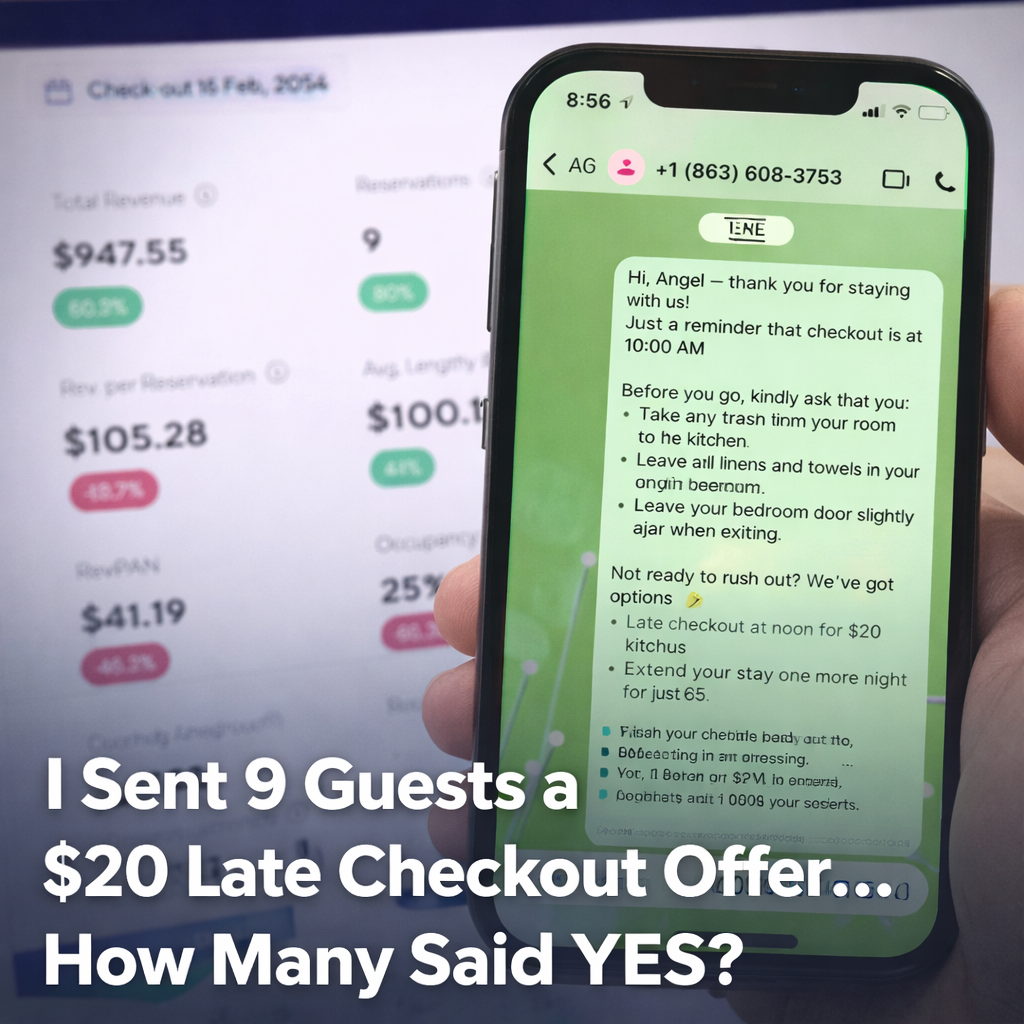
I Sent 9 Late Checkout Offers This Week… How Many Guests Will Say Yes?
This Sunday we had 9 checkouts.
Before each guest left, we sent a simple upsell:
• Late checkout at 12PM for $20
• Extend one more night for $55–$65No complicated funnel.
No automation sequence.
Just a direct, well-timed offer before departure.So the real question is:
Out of 9 guests… how many will take it?
🎯 ChatGPT Prediction
Based on short-term rental upsell behavior and same-day checkout psychology:
• Late checkout conversion: 10–25%
• Same-night extension conversion: 5–15%
• Combined realistic conversion: 15–30%Applied to 9 guests:
• Conservative outcome → 1 guest
• Strong week → 2 guests
• Exceptional week → 3 guestsMost statistically likely result:
👉 1–2 guests accept the offer
💰 What That Means
If 2 guests take late checkout → +$40 revenue
If 1 guest extends a night → +$55–$65 revenueZero extra marketing spend.
Same inventory.
Pure margin.This is what small operational optimizations look like inside a short-term rental business.
Not flashy.
Not viral.
Just consistent revenue stacking.
📊 Why This Works
Checkout timing creates:
• Scarcity
• Emotional friction (not wanting to leave)
• Convenience biasThe guest is already there.
The room is already clean.
The decision window is small.That’s when conversion probability spikes.
This isn’t theory.
It’s real-time testing inside an active portfolio.
Follow along as we track the results.
How many Airbnb guests accept late checkout offers?
Typically, 10–25% of guests accept a paid late checkout offer when presented on the day of departure.
Does offering a same-night extension increase revenue?
Yes. Offering a same-night extension can convert 5–15% of checkouts and significantly increase per-reservation revenue with no additional acquisition cost.
What is the most realistic conversion rate for checkout upsells?
For short-term rentals, a combined 15–30% conversion rate is realistic when both late checkout and extension options are offered clearly and directly.
-
Voce Sabia do HIS da minha casa minha vida?
Há mil e uma maneiras de realizar o sonho da casa própria — seja para morar, seja como seu primeiro investimento imobiliário.
Marcelo Maccan compartilhou com a equipe da Catalyst Win alguns dos principais programas da Caixa Econômica Federal, mostrando como é possível catalisar a independência financeira por meio do crédito imobiliário, sem descapitalizar, sem perder o estilo e com planejamento inteligente.
Dentro do modelo de Habitação de Interesse Social (HIS), o comprador pode acessar condições diferenciadas, com financiamento vinculado à evolução da obra, juros e seguro cobrados de forma proporcional ao avanço do projeto e carência durante o período de construção. Em muitos casos, o financiamento permite iniciar o projeto hoje e só assumir o pagamento integral após a entrega do imóvel.
Além disso, dependendo do perfil e da localização, o imóvel pode gerar renda mensal com locação, criando uma combinação poderosa entre moradia, patrimônio e fluxo de caixa.
Quando bem estruturado, o HIS não é apenas uma solução habitacional — é uma porta de entrada estratégica para o mercado imobiliário, especialmente para quem busca a primeira aquisição ou quer transformar crédito acessível em alavanca financeira de longo prazo.

Na Catalyst Win, ajudamos você a entender as regras, os riscos e as oportunidades, traduzindo programas públicos em decisões privadas inteligentes.
Construir patrimônio começa com informação. E o próximo passo é sempre o mais importante.