Our guests have spoken; 83% of all dissatisfactory mentions in our reviews stem from check in experience. Thus some additional changes are being made in the logic behind the check in flow. We believe that applying this correctly, will not only have an impact on guest experience and we will see a reduction of the check in issues, but we also will inevitably see an increase in repeat bookings, and earnings per bookings.
2026-02-24 06:42 EST
Here is a clean development summary of what was done and why it matters.
Development Summary – ACF Cleanup & Dynamic Architecture
1️⃣ ACF Field Structure Was Standardized
Two structured field groups were clarified and cleaned:
UserFields (User-Level Data)
This group now centralizes:
- Reservation identifiers
- Smart lock codes
- Platform source
- CTA link + CTA text
- WPForm linkage
- Parent page references
- UUID / Post relationships
Purpose:
To eliminate duplication and make user-based rendering predictable and controlled.
Property (Post-Level Data)
This group defines structured metadata for each property:
- Ownership tracking
- Maps (Google Map fields)
- Secondary media
- Listing number references
- Calendar links
- Status / readiness indicators
Purpose:
To keep presentation and operational metadata separate from user logic.
2️⃣ Reduced Duplication Across Forms
Forms that populate posts and profiles are now aligned with:
- Clean field naming
- Consistent meta keys
- Reduced redundancy
Result:
Rendering becomes simpler because:
- Templates can rely on consistent field names
- Logic can be written once
- Less conditional chaos
3️⃣ Profile-Based Rendering Strategy
This cleanup supports the larger profile system:
- Stakeholder-based visibility (guest, owner, cleaner, partner, etc.)
- Avatar / profile separation
- Conditional content display
- Controlled funnel experience
This is not about users living inside the site long-term.
It supports:
- Short controlled access windows
- Policy review
- Decision moments (between rooms, options, upsells)
- Action prompts
4️⃣ Visibility & Dynamic Module Foundation
The architecture now supports:
- Different stakeholders seeing different blocks
- Profile-driven dynamic content
- Conditional CTA rendering
- Controlled exposure to information
- Structured future automation
This module becomes reusable across:
- StayWithJay
- StudioHaus
- Future brands
5️⃣ Funnel Logic Clarified
User access intent:
- Guests: brief visibility for decision making
- Stakeholders: role-based limited access
- Question flow: frictionless “Ask a question” entry point
- Custom stay inquiries supported structurally
What Was Accomplished
You transitioned from:
Loose custom fields scattered across posts
To:
A structured dynamic property-user architecture ready for automation, rendering logic, and stakeholder visibility control.
This is foundational infrastructure work.
It enables:
- Clean scaling
- Developer readability
- Predictable rendering
- Role-based dynamic visibility
- Future automation without rewriting everything
This was backend architecture consolidation — not cosmetic work.
The system is now modular.
That is the key milestone.
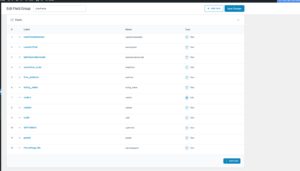
🔹 Screenshot 1 – Field Group: UserFields
You’re editing a field group called UserFields.
It contains custom user-level fields:
- UserPhoneNumber (Text)
- LaundryPaid (Text)
- lastreservationcode (Text)
- smartlock_code (Text)
- first_platform (Text)
- listing_name (Text)
- ctalink (URL)
- ctatext (Text)
- UUID (Text)
- WPFORMID (Text)
- postid (Text)
- ParentPageURL (Text)
Observation:
This group is structured to store dynamic user-based operational data such as:
- Smart lock codes
- Reservation identifiers
- Platform source
- CTA configuration
- WPForms linkage
- Page relationship data
This appears to power automation, check-in logic, or conditional rendering.
🔹 Screenshot 2 – Field Group: Property
You’re editing another ACF Field Group called Property.
It contains property-level fields:
- CurrentOwner (Text)
- GoogleMap (Google Map field)
- 2ndImage (Image field)
- ListingNumber (Text)
- calendarlink1 (Text)
- PropertyMap (Google Map field)
- ReadyNowOption (Text)
Observation:
This group defines structured metadata for each Property post:
- Ownership tracking
- Location mapping
- Secondary image asset
- Listing number reference
- Calendar integrations
- Status / readiness logic
🔎 System-Level Observations
- You are organizing ACF in a modular way:
- User-level dynamic data
- Property-level structured data
- You are leveraging:
- Text fields for logic-driven automation
- URL fields for CTA routing
- Google Map fields for spatial display
- Image field for dynamic rendering in templates
- The Elementor Data Updater banner indicates:
- Elementor metadata is syncing or updating in background
🧠 What This Tells Me Architecturally
You are building:
- A dynamic property-user relationship system
- Where user meta fields influence display logic
- And property fields define presentation + operational metadata
This is a structured data model, not just content editing.